 ESG
Compliance
- Home
- Ethics and Governance
- Compliance
Compliance Basic Policy and Compliance Promotion System
Compliance Basic Policy
PLDRM, the Asset Manager, has established the “Compliance Basic Policy” to promote compliance pertaining to its asset management activities regarding NPR based on the “Compliance Rules”, as follows:
- PLDRM recognizes that inadequate compliance could undermine our management foundations. We deem thorough compliance to be one of the most important management issues.
- PLDRM recognizes that we are socially required to carry out our business responsibly as a financial instruments business operator. We are actively and constantly working on compliance in order to increase our business value qualitatively and quantitatively.
- PLDRM tries to contribute to economic and social development by working on compliance activities described in the above 2. and aims to raise the reputation from investors and gain the trust from every stakeholder around the world.
Compliance Promotion System
PLDRM stipulates basic components regarding the compliance system of PLDRM in accordance with the Compliance Rules, the “Compliance Manual” and other rules. PLDRM strictly complies with laws and regulations related to its business, carries out sound and sincere corporate activities, and has established a system to ensure the soundness of management based on self-discipline.
The compliance promotion system consists of the Board of Directors, the Compliance Committee and the Compliance Officer. The Board of Directors formulates basic policies and other basic matters regarding the promotion of compliance, appoints and dismisses an independent member of the Compliance Committee, and formulates and revises the Compliance Manual and compliance programs. The Compliance Committee deliberates on the formulation and revision of the Compliance Manual and compliance programs, and deliberates and resolves other matters related to compliance. The Compliance Officer plans and promotes overall compliance activities as the person in charge of legal compliance.
The Compliance Officer has independent authority in the PLDRM’s decision-making process regarding NPR's asset management, and plays an important role in the compliance promotion system.
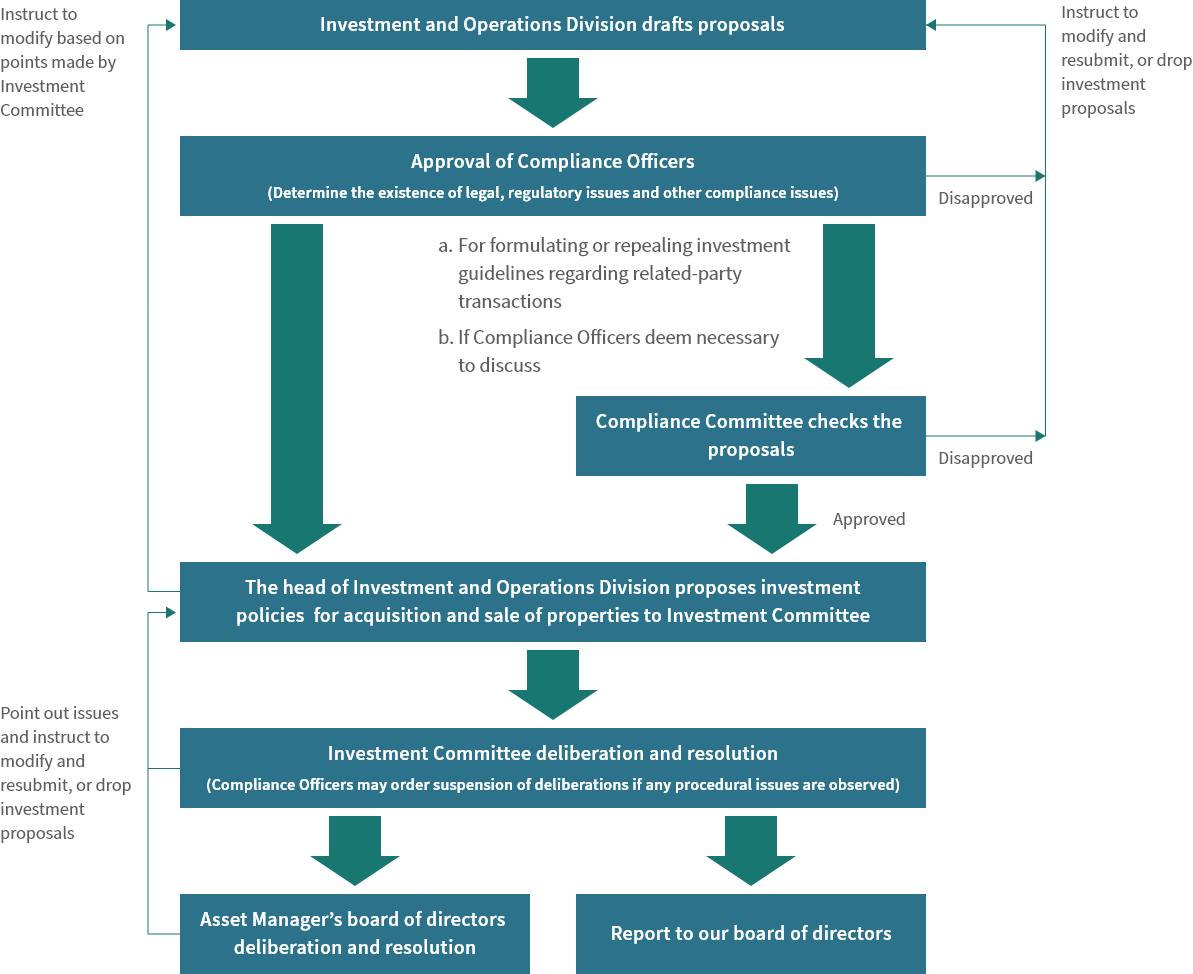
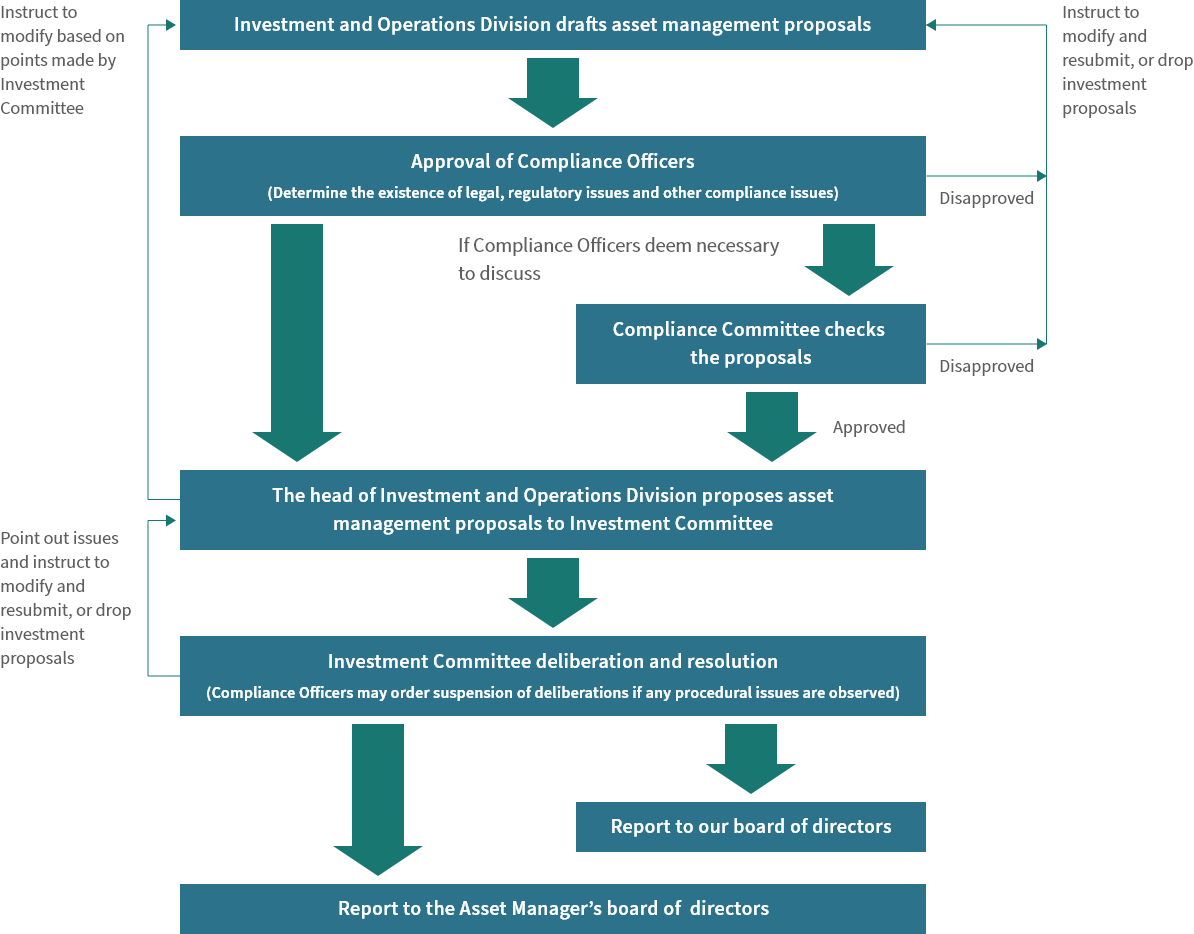
In order to practice compliance activities, the Compliance Officer formulates and maintains internal rules such as the Compliance Manual as a code of conduct that serves for officers and employees. In addition, the Compliance Officer plans and implements guidance and training for officers and employees on a regular basis or necessarily based on the compliance programs, etc.
Number of compliance trainings conducted based on the compliance program
| CY 2020 | CY 2021 | CY 2022 | CY 2023 | CY 2024 | CY 2025 | |
|---|---|---|---|---|---|---|
| Number of Compliance Trainings (Including E-learning) |
4 | 4 | 4 | 5 | 9 | 6 |
- The compliance trainings are conducted for all employees of PLDRM, including contract and temporary employees.
Rules Regarding Related-Party Transactions
PLDRM has adopted an internal set of rules that apply to all related-party transactions, which include property and security acquisition, disposition and leasing, property management outsourcing, real estate brokerage services outsourcing (such as for trades and leases) or placing construction orders. In order to prevent conflicts of interest, PLDRM shall comply with relevant laws and regulations for all transactions, including with parties other than related parties, and shall not conduct its business in a way which causes conflicts of interest or which undermines our interests when conducting transactions with related parties and shall not conduct unnecessary transactions.
Procedures for Related-Party Transactions
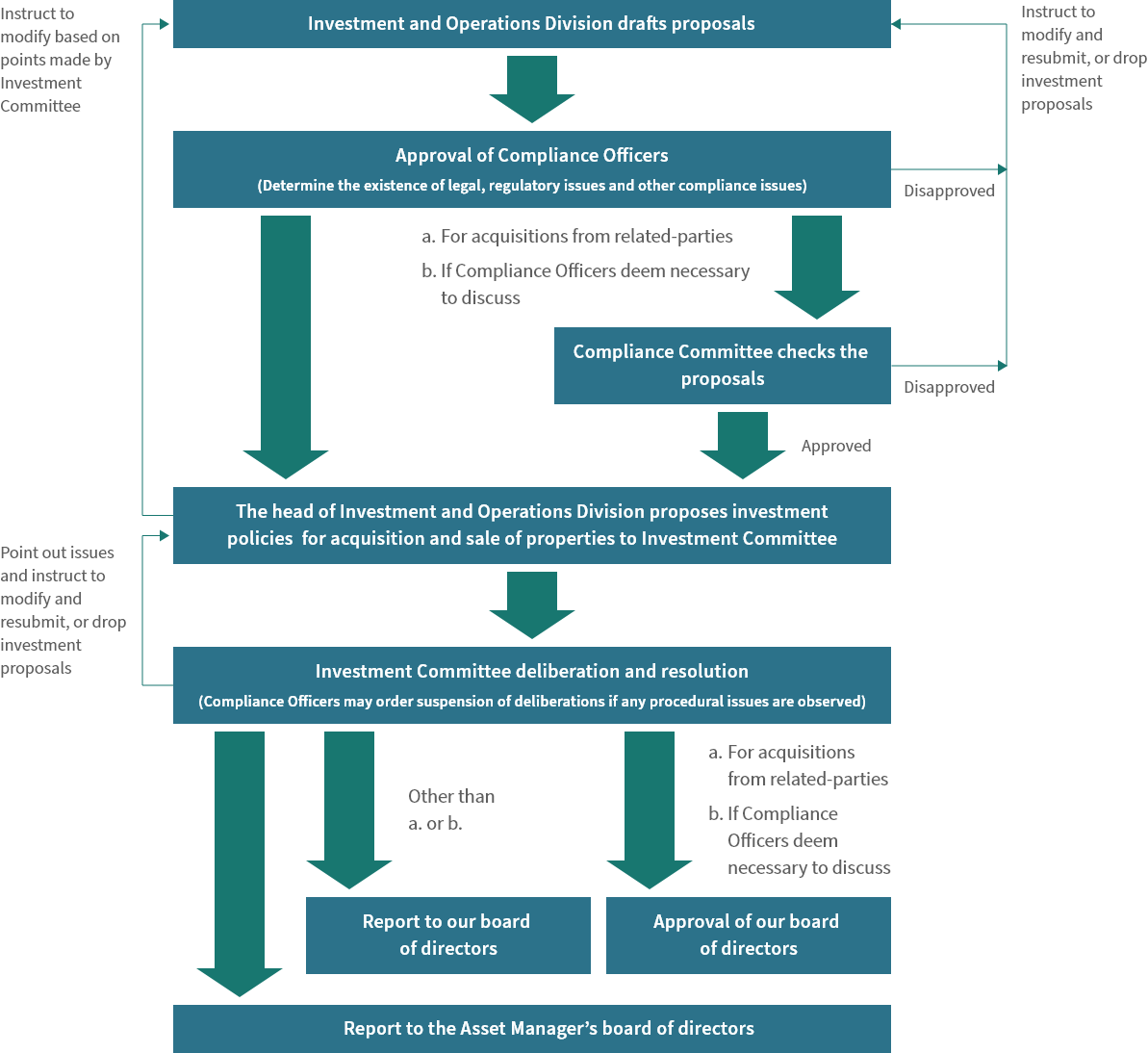
These rules require PLDRM to obtain preliminary approval from the Compliance Officer, who determines whether there is any compliance issue from a compliance viewpoint after reviewing the compliance status of the related-party transactions with the applicable laws, regulations and rules set by NPR and PLDRM, prior to entering into the transactions.
Following this preliminary approval, the proposal is submitted to the Compliance Committee for deliberation. If the Compliance Committee approves it, the proposal is then submitted to the Investment Committee for deliberation. If the Investment Committee approves the proposal, the transaction is carried out. The head of the Investment and Operations Division reports the details of the transaction to PLDRM’s Board of Directors and NPR’s Board of Directors before implementation or promptly after implementation.
Transactions with interested parties involving the acquisition, disposition or lease of real estate or securities (excluding transactions designated under the Enforcement Regulations of the ITA as having only a minor impact on NPR’s assets), as well as any other related-party transactions deemed necessary by the Compliance Officer, must be deliberated by the Compliance Committee, and NPR’s consent must be obtained based on approval by NPR’s Board of Directors.
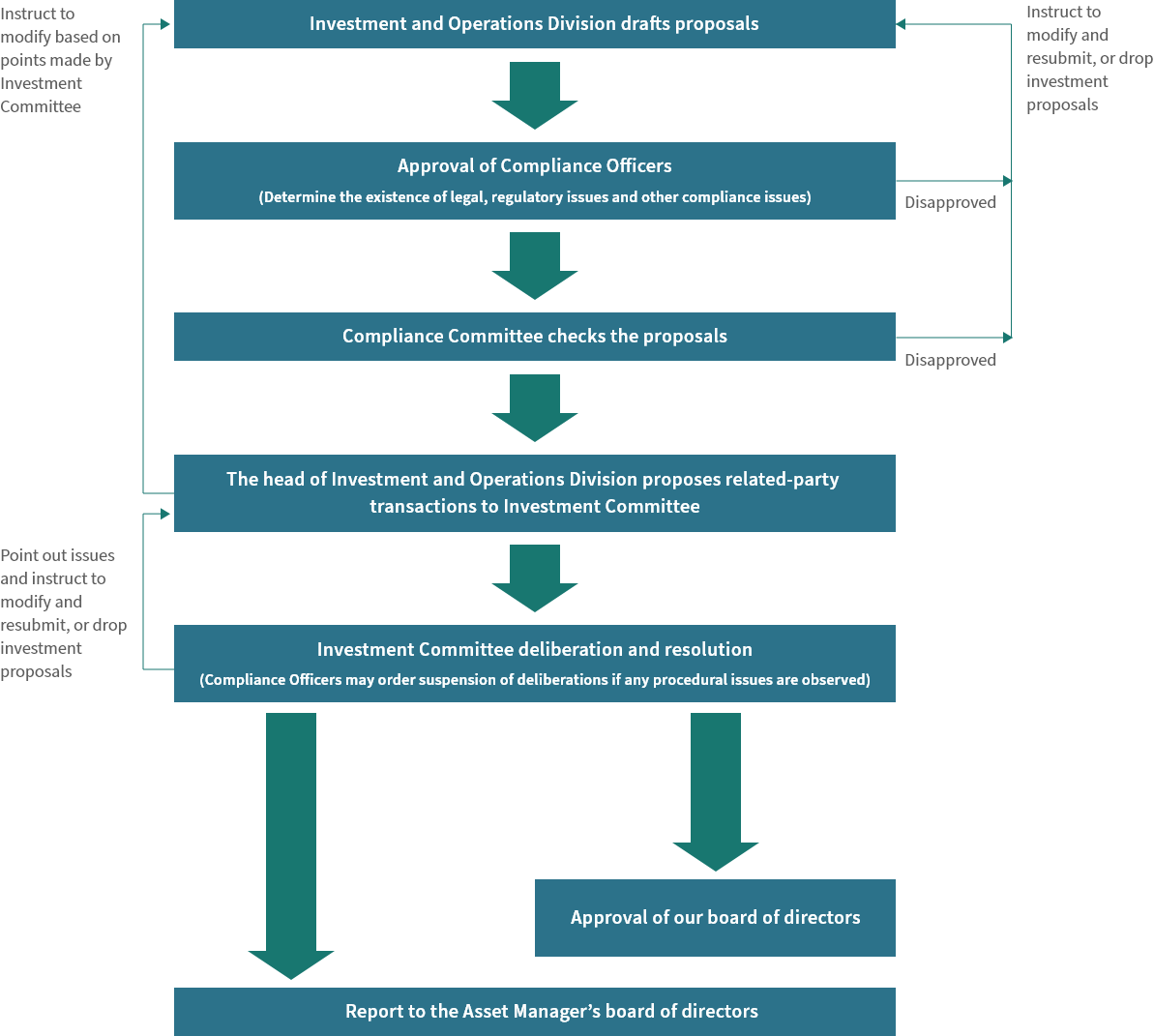
From the perspective of ensuring transparency, related-party transactions are promptly disclosed to the public in an appropriate process in accordance with applicable laws, regulations and related rules.
Internal Audits for the Asset Manager
Internal audits for PLDRM are conducted by the Compliance Officer, who is independent of other divisions, at least once a year for each division, in principle.
Internal audits also verify whether the business activities and operations of each department are conducted appropriately and efficiently in accordance with the Financial Instruments and Exchange Act, the Act on Investment Trusts and Investment Corporations, other relevant laws and regulations, the rules established by the Investment Management Association of Japan (IMAJ), and PLDRM’s internal rules. From the perspective of detecting and preventing misconduct or gross negligence, the audits also review the development and operation of the compliance framework, including matters related to business ethics and anti-corruption.
The Compliance Officer drafts an annual internal audit plan at the beginning of each fiscal period and submits it to PLDRM’s Board of Directors for deliberation and resolution. The Compliance Officer prepares an internal audit report summarizing the results of the internal audits and submits it to PLDRM’s Board of Directors promptly after completion of the audits. Based on the audit results, the Compliance Officer also makes recommendations or issues instructions for improvement to the relevant departments, as necessary.
In addition, PLDRM’s Board of Directors or the Compliance Officer may arrange for an external audit by outside experts if deemed necessary.
BUSINESS ETHICS, ANTI-CORRUPTION AND ANTI-BRIBERY INITIATIVES
The Prologis Group’s Code of Ethics and Business Conduct (CEBC) applies to all officers and employees of the Prologis Group, including those of PLDRM. Each year, PLDRM requires all of its officers and employees to complete training on the CEBC, pass a completion test, and pledge to comply with the CEBC. The Prologis Group also provides officers and employees with ongoing training and other opportunities to strengthen their ethical awareness and ethical decision-making skills. Officers and employees of PLDRM may also participate in these programs.
The Prologis Group does not tolerate bribery, corruption or money laundering and requires all officers and employees to comply with applicable laws, including the U.S. Foreign Corrupt Practices Act (FCPA). The Prologis Group maintains a group-wide FCPA policy and provides anti-corruption and anti-bribery training, which also applies to officers and employees of PLDRM. Officers and employees are strongly encouraged to promptly report any actual or suspected FCPA violation to the Legal Department.
The CEBC sets standards for gifts and entertainment, political activities and contributions, charitable donations and sponsorships, and prohibits officers and employees from engaging in bribery and corruption in connection with these activities. It also prohibits officers and employees from engaging in conduct that may suggest improper ties with political or government officials, illegal conduct, or gifts, entertainment or hospitality involving customers or suppliers that exceed generally accepted standards.
Through these initiatives, the Prologis Group actively promotes adherence to its standards of business ethics and conduct. Nippon Prologis REIT, Inc. and PLDRM do not make political contributions or provide anything of value that would violate the Prologis Group’s Code of Ethics.
VIEW NPR’S ESG DATA
Whistle-Blower System in the Prologis Group
PLDRM and Prologis Japan have established a whistle-blowing system to help provide employees with a safe and comfortable working environment. All employees may directly contact either the Compliance Officer or the Head of the Personnel and General Administration Division of K.K. Prologis to report or seek advice on workplace harassment matters.
In addition, the Prologis Group provides a global whistle-blower channel for compliance concerns that is managed by a third party and ensures anonymity. All employees in Japan have access to this channel. The Prologis Group prohibits retaliation against anyone who raises a concern in good faith or cooperates with an investigation. Reports are investigated as necessary, and appropriate corrective or disciplinary action is taken when a violation is confirmed.
Safety Helpline
Ensuring the safety of all stakeholders such as customers and suppliers, as well as every employee in the Prologis Group, including PLDRM, is a priority for us. The Prologis Group has established a safety helpline that allows all stakeholders inside and outside NPR, PLDRM and other Prologis Group companies to call out issues that they find at a jobsite or in their work environment where safety practices are not being properly followed. The Safety Helpline is managed by a third party to ensure anonymity.